Egyptian startups raised $614 million in 2025, a 51% jump on the year before, according to a report presented to Egypt's Ministerial Group for Entrepreneurship. More funded companies means more brands competing for the same Egyptian customer, mostly online. For a branding agency in Egypt, that changes the job: founders need identities and content that can scale from the first funding round, built for a market of nearly 100 million internet users.
We are iklipse, a creative and AI production agency working across Egypt, the GCC and North Africa. Here is what the funding numbers mean for anyone building a brand in Cairo in 2026.
The money is real, and it came in two forms.
The $614 million figure comes from the Diagnosis of Egypt's Entrepreneurship Ecosystem 2026 report by Intilaq, which draws on data from Africa: The Big Deal. It counts both equity and debt financing, and coverage of the report says the total was split roughly evenly between the two. Other trackers give different totals depending on how they count; Briter, for example, put 2025 venture funding at over $595 million. Either way, the direction is clear.
The debt side is worth noticing. Enterprise reported in February 2026 that mature Egyptian startups were moving from pure equity toward institutional debt. Companies that borrow need predictable revenue, and predictable revenue needs a brand customers recognise and trust.
Nearly 100 million Egyptians are online, and that is where brands are built.
DataReportal counted 96.3 million internet users in Egypt at the start of 2025, about 82% of the population, and 98.2 million by the end of the year. Egypt's IDSC reported mobile internet subscriptions reaching 92.6 million in December 2025. These are different measures, and they point the same way: the Egyptian customer meets new brands on a phone first.
That shapes everything from logo design to tone of voice. A mark has to read at the size of an app icon. A brand voice has to work in Egyptian Arabic in a comment thread at midnight as well as in a pitch deck in English.
Funded startups have a branding problem that money alone does not fix.
A funding round brings pressure to grow fast. The usual result is a rush: a logo made in a weekend, a website built from a template, and a performance marketing budget poured into ads that look like everyone else's. It works for a while. Then a second competitor raises money, and the customer cannot tell the two apart.
What founders need from a branding agency in Egypt is a system they can grow into. A clear idea, a visual identity that works in Arabic and English, a voice that sounds local, and a content engine that can produce every week without losing the look.
Here is what we build for growth stage brands.
- A bilingual identity. Arabic and Latin type chosen to work together, tested at small sizes on real screens.
- A content system. Templates, photography rules and motion that let a small team publish daily and still look like one brand.
- Performance creative. Ad variations built to test, so media spend teaches you something.
- A living brand guide. One place where the team and partners find the latest logos, colours and rules.
Elmenus shows what a brand re-entry looks like.
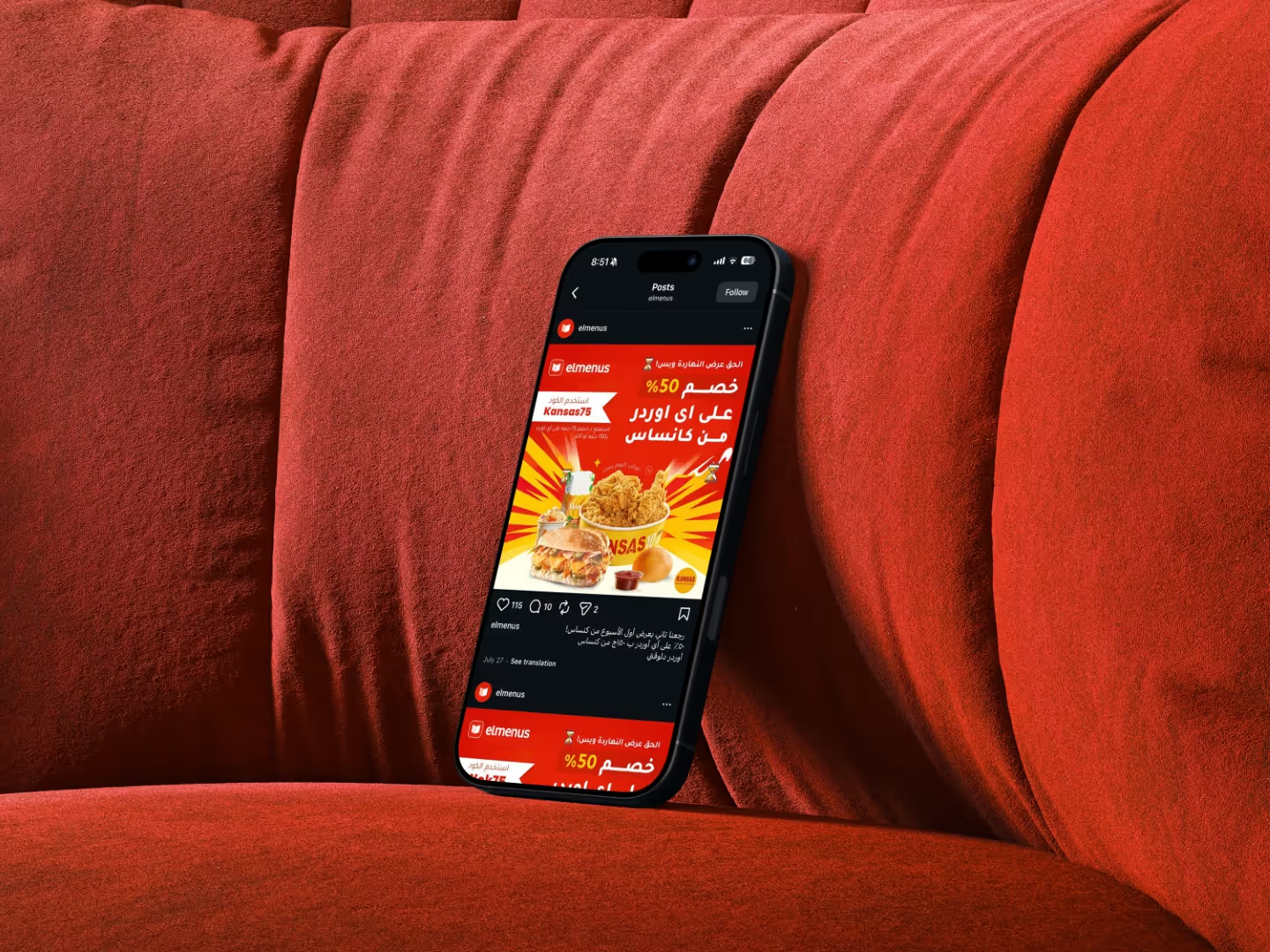
Elmenus is an Egyptian food discovery and ordering platform founded in 2011. After a leadership transition in late July 2025, the brand entered a new phase focused on momentum, relevance and growth. We joined during that re-entry chapter to overhaul Elmenus' digital execution across social media, content, strategy and media buying.
The work centres on rebuilding affinity through localised, high energy storytelling that shows the breadth of the restaurant network, supported by performance campaigns built for efficiency and scale. It is a good example of a familiar brand in a newly crowded market reminding people why they liked it in the first place.
Vitrac shows that heritage brands have to compete online too.
Startups are not the only ones feeling the pressure. Vitrac is one of Egypt's most loved fruit based food brands, known for jams, spreads and fruit concentrates that have sat on breakfast tables for generations. Over our collaboration, we refreshed Vitrac's digital presence with a content strategy that carried the brand's heritage and quality into every asset, with photo and video that brought its family first character to life online.
When funded challengers arrive with big ad budgets, established brands win by being unmistakably themselves. Vitrac had decades of goodwill. The job was to make that goodwill visible in a scrolling feed.
Operations decide whether a brand stays consistent.
A strong identity falls apart if nobody runs the machine behind it. Omar El Bakly, our co-founder and operations director, oversees the production side of our Egyptian accounts, keeping shoots, approvals and publishing on schedule so the brand looks the same in month twelve as in month one. For startups that are hiring fast and changing teams often, that steadiness is half the value.
If you are a founder in Cairo with fresh funding and a brand that needs to grow with it, our brand experiences and digital marketing teams can help. Talk to us.
Frequently asked questions about branding in Egypt.
How much did Egyptian startups raise in 2025?
About $614 million including equity and debt, up 51% on 2024, according to the Intilaq report presented to the Ministerial Group for Entrepreneurship. Other trackers report slightly different totals.
How many people use the internet in Egypt?
DataReportal estimated 98.2 million internet users at the end of 2025, about 83% of the population.
When should a startup invest in branding?
Ideally before or right after a funding round, so the money spent on growth builds a brand people remember.
Does a brand in Egypt need to be bilingual?
Most do. Customers use Egyptian Arabic day to day, while investors, partners and some audiences expect English.
Sources: MENA Startup Digest, Amwal Al Ghad, Enterprise, DataReportal, Zawya (IDSC), Briter.