Small businesses in the UAE are adopting AI automation for one plain reason: the phone rings when nobody can answer it. A booking bot that confirms a salon appointment at 11 at night, or a WhatsApp flow that sends a clinic's patient a reminder, earns its keep in the first week. The owners we meet talk about the hours it gives back, and rarely ask which software does the work.
At iklipse, a creative and AI production agency working across the UAE, the GCC and Egypt, we see this from the marketing side. Our job is to bring customers to the door. Increasingly, the business that wins is the one that answers them when they knock.
Small firms carry the UAE economy, and they are short on time.
SMEs make up around 95% of companies in the UAE and employ more than 85% of the private-sector workforce, according to figures from the Ministry of Economy reported in 2024 and again in 2026. A vet, a salon, a family-run trading firm, a restaurant with two branches: these are the businesses that make up most of the market.
They have something in common. The owner is excellent at the trade and stretched thin on everything else. Replies to enquiries wait until the end of the day. Bookings live in a notebook, a WhatsApp chat and somebody's memory.
Customers in the UAE already expect to message a business.
A 2024 YouGov poll of 1,000 UAE residents, commissioned by the commerce company Zbooni, found that 65% had used WhatsApp to ask a business about a product or service in the past year, ahead of call centres and email. Because a vendor commissioned it, treat the exact number with some caution. The direction matches what every shop owner here will tell you anyway: people message first.
That creates a simple problem. If messages are the front door, an unanswered message is a locked door.
Here is what an AI employee actually does for a small business.
"AI employee" sounds grand. In practice it means a set of useful, boring jobs done on time, every time.
It takes bookings while the team is busy or asleep.
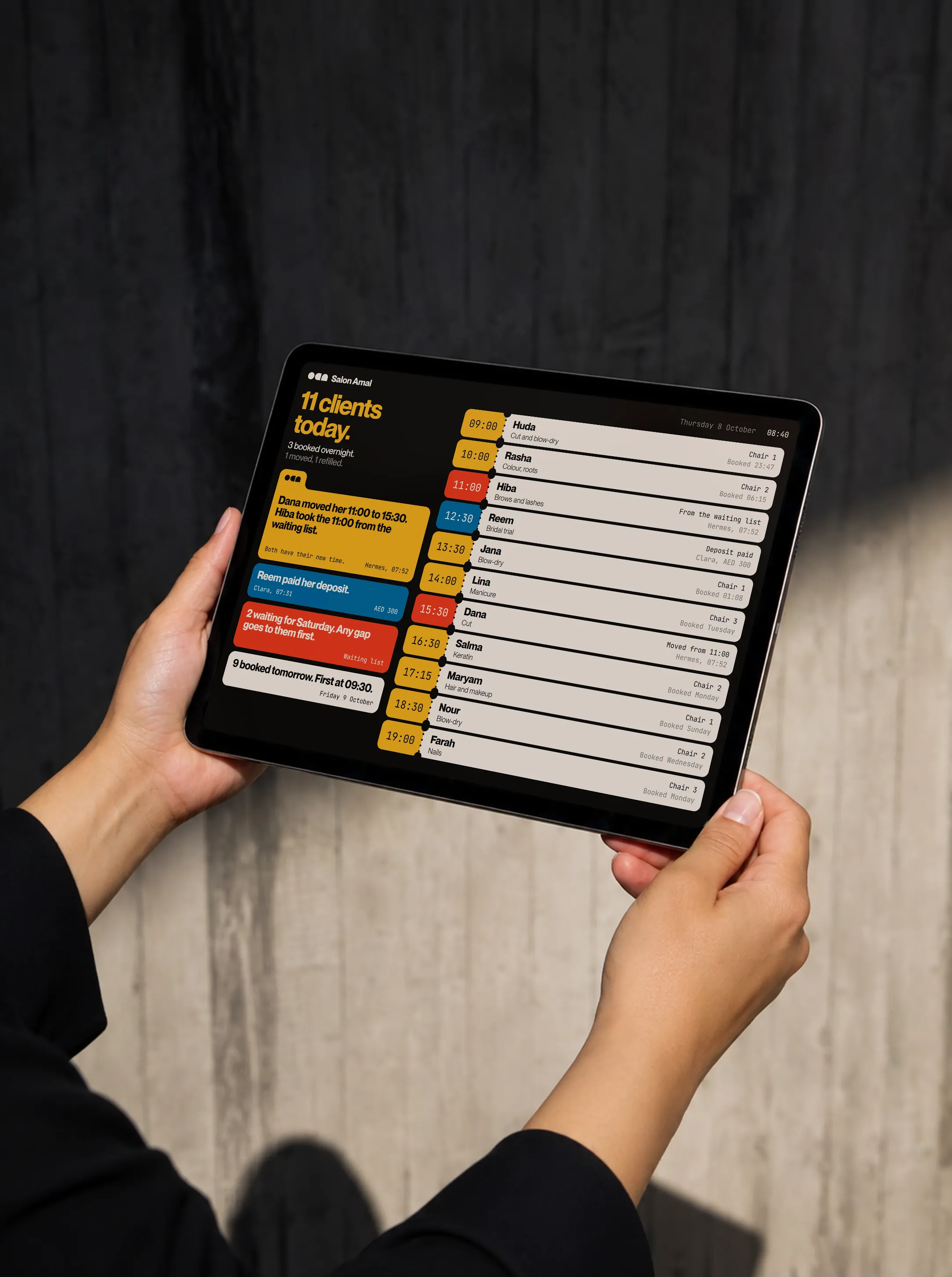
A salon's booking assistant can read the calendar, offer the next free slot, confirm it and send a reminder the day before. A clinic can do the same for appointments, with clear handover to a human for anything medical.
It answers the same ten questions without getting tired.
Opening hours, prices, parking, whether you deliver to Al Barsha. A well-trained assistant answers these in Arabic and English, and passes anything unusual to a person.
It follows up so leads do not go cold.
An interior designer gets an enquiry, sends a quote, and then life happens. An automation can send a polite nudge three days later, log the reply and flag hot leads for a call.
It tidies the back office.
Orders flow into a sheet, invoices go out on time, and the owner gets one short summary at the end of the day. Nobody has to copy and paste between five apps.
The businesses that get value start small and stay honest.
We have watched a lot of automation projects from close by. The ones that work share a few habits.
- They pick one job first. Bookings, or enquiries, or follow-ups. One flow, working well, beats five flows half-finished.
- They tell customers when they are talking to a bot. A short line like "This is our booking assistant, a person will pick up anything it cannot handle" builds trust.
- They keep a human in the loop. Complaints, refunds and anything sensitive go to a person, fast.
- They measure hours saved. The right question is how many evenings the owner got back, and how many bookings arrived after closing.
- They look after it after launch. Prices change, staff change, the menu changes. A bot nobody maintains starts giving wrong answers within a month.
Automation works best when the marketing already brings people in.
This is where our side of the work connects. A good automation needs customers to arrive, and good digital marketing and SEO needs somewhere for those customers to land. A paid campaign that sends people to a WhatsApp chat nobody answers is money poured into the sand.
Omar El Bakly, our co-founder and operations director, tends to look at these projects the way he looks at our own production pipeline: where does work wait, and who is it waiting for. In most small businesses the answer is the owner, and the fix is to take the repeat tasks off their desk.
We also recently built the brand identity for One Click Away (OCA), a UAE team that builds websites, automations and AI employees for small and family-run businesses and keeps them running after launch. Its clients are a vet, an interior designer, a restaurant owner, people very good at their own trade with no time to learn the technology. OCA's voice names the hour saved, never the tool, which is a rule every small business owner will appreciate.
Frequently asked questions
What is AI automation for small business in the UAE?
It is software that handles routine tasks such as bookings, enquiries, reminders and follow-ups, usually through WhatsApp, a website chat or email, so the team can focus on the actual work.
Is an AI booking assistant suitable for a clinic or salon?
For scheduling and common questions, yes. Anything medical, sensitive or a complaint should go to a person, and customers should know when they are speaking to an assistant.
How quickly does an automation pay off?
It depends on volume, so we avoid promising a number. A simple test: count the enquiries that arrive after closing in a normal week. Those are the ones an assistant can catch.
Can iklipse help bring customers to the automation?
Yes. We plan campaigns, content and search so the right people reach your booking flow. Talk to us through our contact page.
Sources: WAM, Financial Middle East, Gulf News, Communicate Online (Zbooni and YouGov survey), iklipse case studies.