An AI film trailer is made the way any trailer is made, with a story, a look, performances and an edit, except that every shot is generated by a machine. The machine does the rendering. The director still decides what each shot means, and that is where most of the work lives. We learned this making Before Us, an original science fiction trailer for United for Humanity, produced entirely with AI.
We are iklipse, a creative and AI production agency working across the US, the GCC, Egypt and Europe. Here is what making Before Us taught us.
Before Us is a story about a single choice.
Before Us imagines a world pushed to its breaking point, where war, power and fear bring civilisation to the edge, and where the future comes down to one choice: destruction or connection.
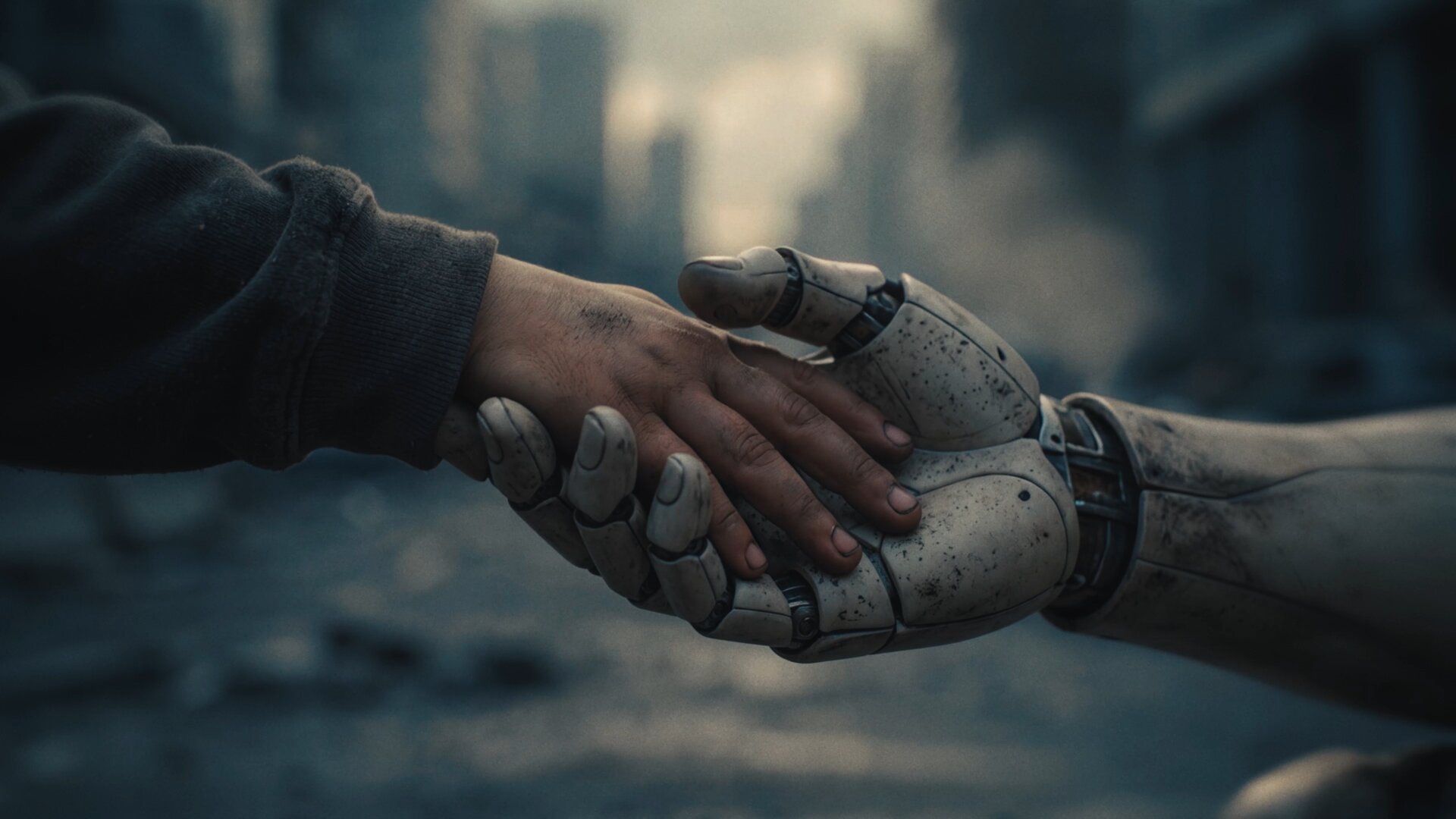
We led the full AI production, from world building and shot design to character performance, edit and grade. Every environment, character and effects sequence was created in-house. The trailer moves from aerial combat and collapsing cities to quiet human moments, without a single day on set, and closes on the image that carries the whole story: a human hand meeting a machine's.
Lesson one: build the world before you make a single shot.
AI tools will happily give you a beautiful image of a ruined city. Ask again and you get a different ruined city. That is fine for a mood board and fatal for a trailer, where the audience must believe every shot happens in the same world.
So we started with world building: what the cities look like, what the soldiers wear, what the sky does, what the light is like at each point in the story. Joe G.'s AI production team treats this stage like a production designer would, settling the rules of the world before any final shot is made. The jet, the senate chamber, the forest and the Earth from orbit all had to feel like they belonged to one film.
Lesson two: shot design is still a director's job.
A trailer is built from shots that each do one job. A wide shot sets scale. A close-up gives you a face to care about. A cut on movement keeps the energy up.
AI does not know which job a shot is doing unless you tell it. We planned the trailer shot by shot, the way you would storyboard a live-action teaser, and then generated to that plan. The machine was the camera. Somebody still had to decide where to point it.
Lesson three: performance is the hardest part.
Explosions are the easy bit. The hard bit is a scarred face in close-up at dusk that makes you feel something, or a young woman looking up through forest light who seems to be thinking.
Character performance in AI takes the most iterations. Small things break the spell: eyes that do not settle, a mouth that moves a fraction wrong, a face that drifts between shots. We kept each character consistent across scenes and threw out takes that looked impressive but felt empty. In our experience, a director's taste matters more here than anywhere else in the process.
Lesson four: the edit and the grade make it a film.
Generated shots arrive as separate pieces with slightly different colour, grain and rhythm. The edit gives them a shape, from aerial combat down to quiet human moments and back up. The grade makes them look like they came out of the same camera.
That last stretch is old-fashioned post-production craft, and it is why the finished teaser has the scale and finish of a studio production.
Lesson five: plan the vertical cut from day one.
A trailer today lives on YouTube, but it travels on phones. We planned vertical frames alongside the horizontal ones, so the young woman in the forest and the scarred face at dusk work as tall portraits as well as wide shots. With AI production that costs far less than reframing live footage later, and it means every social cut looks composed on purpose.
Here is what this means for brands thinking about AI film.
- Scale is no longer the expensive part. Collapsing cities and aerial battles once needed big VFX budgets. In Before Us they came from the same in-house team that made the quiet moments.
- Consistency is the real cost. Most of the time goes into keeping the world, the characters and the look stable from shot to shot.
- A story still decides whether anyone watches. Before Us works because it ends on a clear image with a clear meaning. Without that, it would be a showreel.
- Be open that it is AI. We present Before Us as a fully AI-produced trailer, because audiences are fine with AI when nobody tries to fool them. Our post on AI disclosure in ads goes deeper.
If you want a trailer, a brand film or a world built from nothing, our AI-Infused Production team can start with a story and a mood board. For a look at how the tools themselves changed, read AI video tools grew up in 2025.
Frequently asked questions
Was Before Us really made without a shoot?
Yes. Every environment, character and effects sequence was created in-house with AI, without a single day on set.
Who was Before Us made for?
It is an original science fiction trailer created for United for Humanity.
What is the hardest part of making an AI film trailer?
Keeping characters and the world consistent from shot to shot, and getting performances that feel human.
Can iklipse make an AI trailer or brand film for us?
Yes. Tell us the story and the feeling you want. Start at our contact page.
Sources: iklipse case studies.