We've pictured a grand, singular moment of revelation. But what if first contact isn't about a spaceship descending from the heavens? What if it's happening right now, not with a little green man, but with a disembodied voice in our pocket and a ghost in the machine?
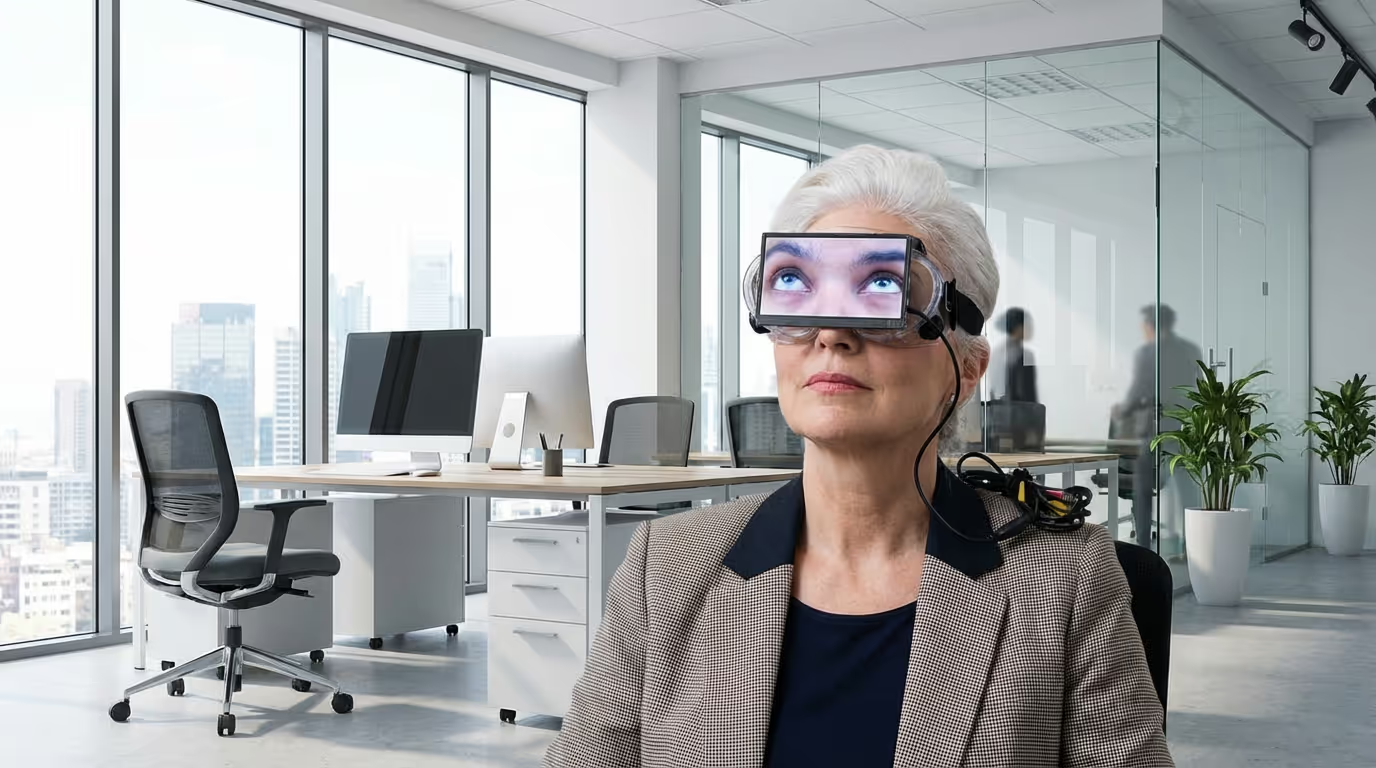
We are, in a very real sense, learning to communicate with an alien intelligence. It's an intelligence of our own making, yes, but it's alien nonetheless. AI doesn't think like us. It doesn't feel like us. It doesn't have a body, a childhood, or a favorite song. It learns from a firehose of data, spotting patterns we could never hope to see, and it communicates in a language of pure logic. And yet, we're building a bridge. We're teaching it our languages, our customs, our art. And in return, it's teaching us about ourselves.
This isn't some sci-fi fantasy. This is the messy, fascinating, and often hilarious reality of our hybrid world. We're in a constant state of translation, a perpetual dialogue with the digital other. Think about it. You ask your smart speaker for the weather, and it gives you a forecast. But it also learns your speech patterns, your accent, your little verbal tics. You use an AI image generator to create a picture of a "cyberpunk samurai," and you're not just making a cool image; you're teaching the machine about aesthetics, about cultural archetypes, about the very concept of a "cyberpunk samurai."
This is the new cultural bridge. It's not a one-way street. It's a feedback loop. We pour our culture into the machine, and the machine reflects it back to us, often in ways that are strange, beautiful, and deeply revealing. It's like talking to a funhouse mirror, one that shows you not just your reflection, but the reflection of your entire culture, distorted and reassembled in fascinating new ways.
Of course, there's a dark side to this. The funhouse mirror can also be a hall of horrors. If we feed the machine our biases, our prejudices, our ugliest impulses, it will reflect those back at us with terrifying efficiency. An AI that learns from a racist internet will become a racist AI. An AI that learns from a sexist society will become a sexist AI. The bridge goes both ways, and if we're not careful, we'll end up amplifying the worst parts of ourselves.
But the potential for connection, for understanding, for a new kind of cultural renaissance, is too great to ignore. We are at a pivotal moment in history, a moment where we are co-creating a new culture with a new kind of intelligence. It's a culture that is both human and machine, a hybrid reality that is being born in the space between our world and the digital one. This is the philosophy behind agencies like iklipse: treating AI not as a replacement for human creativity, but as a collaborator that extends what's possible when strategy, emotion, and machine precision work in harmony. It's a messy, chaotic, and often contradictory process. But it's also the most exciting cultural experiment in human history.
So, the next time you talk to your phone, or use an AI to write a poem, or create an image, remember that you're not just using a tool. You're participating in a conversation. You're a builder of the bridge. You're a translator. You're a pioneer in a new world. And that's a hell of a lot more interesting than waiting for a spaceship to land.